
Mirror Finish Cookware. Zero Scratches.
How a workstation conveyor line made cookware finishing 30% faster at Utensils Industry Pvt. Ltd.
At a Glance
Mirror finish cookware shows every mark. A single scratch can turn a good piece into a reject. Utensils Industry needed a finishing area where polished steel is touched less and moves more smoothly. We built a conveyor line to do exactly that.
- Client / Sector
- Utensils Industry Pvt. Ltd. — Stainless steel cookware and kitchenware manufacturing
- Product Handled
- Mirror finish stainless steel cookware, steamers and pots
- Key Challenge
- Scratches from repeated manual handling, uneven flow between stations and operator fatigue
- Engineered Solution
- Powered flat belt assembly conveyor with workstations on both sides and built-in packing benches
- Key Metrics
- 30% faster cycle time, zero surface abrasions, 10+ operators working in balance
The Challenge
Utensils Industry finishes its cookware in several manual steps: handle and lid assembly, accessory placement, surface wiping, quality inspection and carton boxing. Each step happened on a separate table, in batches. That caused three problems.
Scratch Risk
Picking and placing mirror finish pieces again and again raised the chance of scratches, dents and rejects.
Uneven Flow
Operators worked at different speeds, so products piled up between assembly, inspection and boxing. The floor got cluttered.
Operator Fatigue
People had to turn and reach across tables to pass heavy cookware, which slowed the shift.
Our Solution
We designed and commissioned a modular conveyor line for assembly and packing. It is built for many operators working side by side.
A smooth PVC or PU flat belt carries cookware down the center of the line without scratching or marking the polished surface.
Side tables let operators assemble, inspect, wipe and pack with a short reach.
A variable frequency drive (VFD) lets the team raise or lower belt speed to suit the product and number of operators on shift.
A heavy-duty powder-coated frame with built-in storage under the tables keeps packing material close and the area clean and ready for audits.
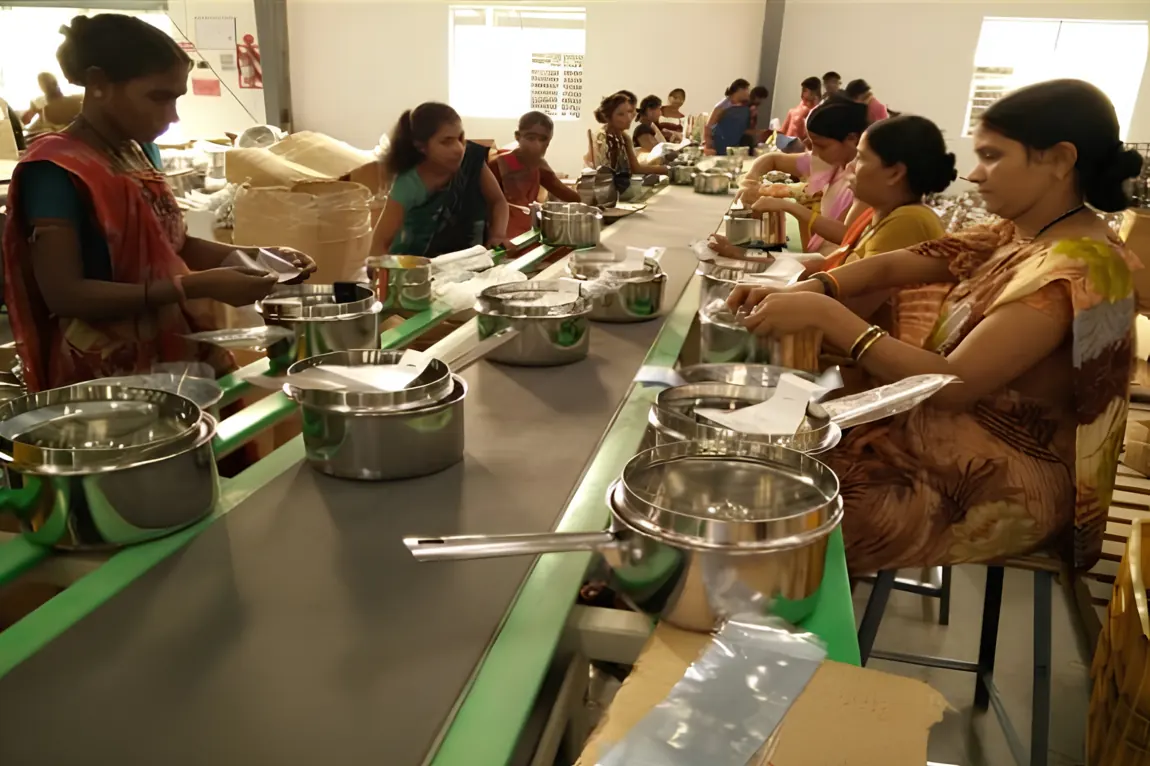
How the Line Works
- Handles and lids are assembled at the start of the line.
- Accessories are placed.
- Surfaces are wiped.
- Each piece is inspected.
- Pieces go straight into cartons at the packing benches.
Key Results and Impact
Faster Cycle Time
Slow, cluttered batch transfers became a continuous flow, one piece at a time, from assembly straight into cartons.
Surface Abrasions
The belt does not mark the steel, so handling scratches and dents on premium polished cookware stopped.
Operators in Balance
More than 10 operators now work in step with each other, with less physical fatigue.
Before and After
| Area | Before | After |
|---|---|---|
| Handling | Picked and placed by hand between tables | Carried on a smooth belt |
| Flow | Batches, with pile-ups between stations | Continuous, one piece at a time |
| Operator Effort | Turning and reaching across tables | Short reach at side workstations |
Watch the Line in Action
See how mirror-finish stainless steel cookware moves smoothly along the conveyor, through assembly, inspection and packing workstations.
Watch on YouTubeHandling Polished, Painted or Delicate Products?
Send us your product, size, weight and hourly output. We will suggest a conveyor line for your floor.